Article · Writing
You Can't Delegate Accountability Without Delegating Authority
Why organizations that want to move faster, innovate, and successfully adopt AI need to rethink who has the authority to make decisions.
I usually write about artificial intelligence, its adoption, and the opportunities and challenges it creates for organizations. But occasionally, I want to write about something more foundational: how organizations actually work.
Because here's something I've learned from years of leading organizational change: Technology cannot fix a broken management structure.
We spend enormous amounts of time discussing how AI will transform organizations, accelerate decision-making, and improve productivity. But before AI can deliver on those promises, organizations need to address some fundamental questions about their people, processes, and management practices.
One of the most important, and frequently overlooked, is delegation of authority.
If an organization wants to innovate, move quickly, and adapt to change, it needs to ensure that the people responsible for delivering results actually have the authority to do so.
Unfortunately, many organizations are much better at delegating accountability than delegating authority.
The Accountability Trap
Consider the position organizations routinely put middle managers and supervisors in.
We assign them ambitious goals, hold them accountable for performance, and demand that they find ways to improve operations. But we often fail to give them the corresponding authority to make the decisions necessary to achieve those goals.
When that happens, managers generally have two choices.
The first is to follow the chain of command, request approvals, wait for decisions, and accept the delays. They may do everything correctly from a procedural standpoint and still fail to deliver the results expected of them.
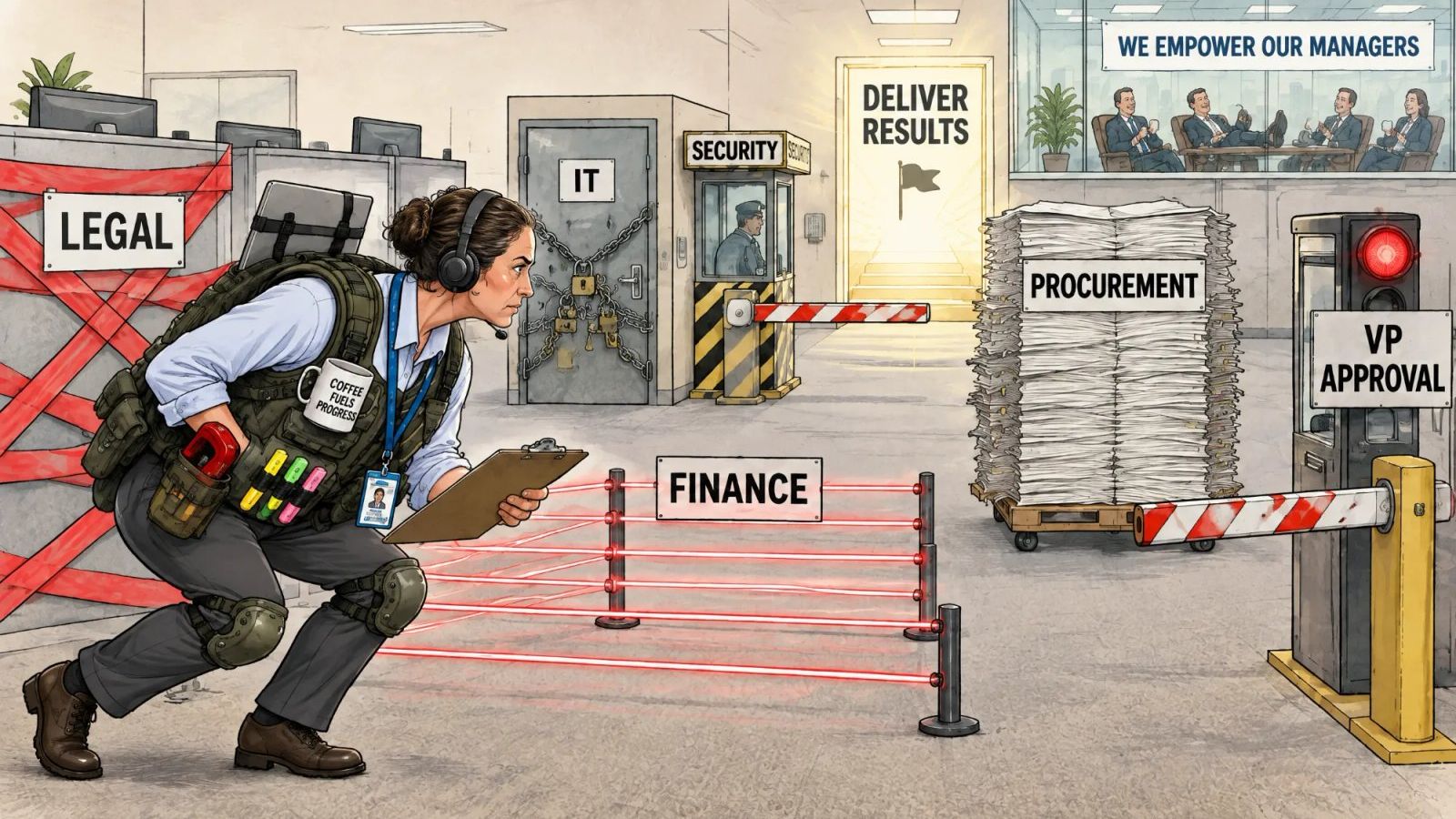
The second is to become what I think of as an organizational commando.
These are the managers who operate like special forces behind enemy lines, navigating organizational obstacles, building informal alliances, negotiating favors, and doing whatever it takes to accomplish their mission.
They learn who can get something approved, which executive can resolve a dispute, and whose support is necessary to move a project forward. They rely on relationships, persuasion, and the occasional creative workaround to achieve outcomes their job descriptions suggest they should already have the authority to deliver.
Organizations frequently celebrate these people as exceptional leaders.
And to be fair, many of them are.
But we should ask ourselves why they need to be exceptional just to do their jobs.
If delivering results requires someone to operate like a special forces soldier behind enemy lines, your organization has a structural problem, not a leadership success story.
There is another important dimension to this problem.
Executives with C-level, vice president, or department head titles often benefit from substantial perceived positional authority. People assume they have the power to make decisions, even when the precise boundaries of that authority aren't documented.
Middle managers and supervisors rarely enjoy that same presumption.
Without formal delegation, they must rely disproportionately on soft power: personal credibility, persuasion, relationships, and their ability to negotiate cooperation.
That takes enormous energy, they get tired, and then they want to quit. It also creates an organizational dependency on particular individuals.
When the successful manager leaves, the relationships and informal arrangements that made the position effective often leave with them.
Organizations should be designing positions that qualified people can succeed in, not positions that require extraordinary personalities to overcome structural weaknesses.
Authority should belong to the position, not depend on the personality occupying it.
When I Learned That My Job Was to Stop Doing the Work
One of the most important transitions in my management career came when I became Deputy Chief Operating Officer for the City of San Diego.
I went from leading a team of approximately 80 people to overseeing an organization with more than 1,000 employees. My direct reports were experienced executives, each responsible for substantial operations, employees, budgets, and public services.
It fundamentally changed how I thought about my role.
At that level, my job was no longer to do the operational work myself.
My job had four essential responsibilities:
- Establish clear strategic direction and expectations.
- Delegate the authority necessary for my executives to deliver.
- Monitor performance and hold people accountable for results.
- Remove obstacles and resolve issues that exceeded their authority.
That was the job.
I remember reviewing the formal delegations of authority associated with my position and realizing just how many things I was technically authorized to do.
I could exercise authority involving building permits, small business loans, federal transportation grants, municipal airports, energy, and a wide range of other governmental functions.
Some pretty interesting stuff.
But having the authority to do something didn't mean I should be doing it.
In fact, if one of my executives came to me seeking approval for something already within their delegated authority, my first question would be why they weren't making the decision themselves.
Every decision unnecessarily elevated to my desk created a delay, consumed executive attention, and diminished the authority of the people I was supposed to be leading.
It also made me a bottleneck.
And when executives become bottlenecks, the entire organization slows down.
I came to believe that a central responsibility of senior leadership is to push decision-making authority to the lowest appropriate organizational level while maintaining clear accountability for outcomes.
This doesn't mean abandoning oversight. Quite the opposite.
When authority is clearly delegated, executives can spend less time approving routine decisions and more time setting direction, monitoring performance, managing risk, and addressing the issues that genuinely require their involvement.
A RACI Is Not a Delegation of Authority
One of the more frustrating organizational management practices I've encountered is the tendency to substitute a RACI matrix for a meaningful delegation of authority.
For those unfamiliar, RACI identifies who is Responsible, Accountable, Consulted, and Informed for an activity or process.
RACI matrices can be useful. They help clarify roles and responsibilities, especially when work crosses organizational boundaries.
But a RACI is not a Delegation of Authority.
A RACI tells you who is responsible for an outcome. A Delegation of Authority tells you who has the power to make the decisions necessary to achieve it.
Consider a manager assigned to improve a permitting process.
The RACI might clearly identify that manager as accountable for reducing processing times.
But can the manager change existing procedures? Require another department to participate? Reallocate resources? Authorize a technology change? Resolve conflicting operational priorities?
If the answer is no, or nobody knows, the organization hasn't really empowered that manager.
It has simply documented who to blame when the improvement doesn't happen.
A meaningful Delegation of Authority establishes the specific decisions a person can make, the boundaries of that authority, the resources they can control, and the conditions under which they must escalate decisions.
It also identifies which decisions remain reserved for higher levels of management or independent control functions.
A RACI can complement that framework, but it cannot replace it.
What Toyota and NASA Teach Us About Authority
Two organizations provide useful, if very different, lessons about the importance of how authority is distributed.
The first is Toyota.
One of the defining principles of the Toyota Production System is jidoka, which emphasizes identifying abnormalities and preventing defects from continuing through production.
Toyota's andon system allows frontline workers to signal problems and initiate a process that can stop production so those problems can be addressed.
Think about the management philosophy behind that.
The organization doesn't assume that every consequential operational decision must originate with an executive. It creates established procedures that allow employees closest to the work to identify problems, trigger intervention, and prevent defects from moving downstream.
The system combines frontline empowerment with clear standards, escalation, and accountability.
That is an important distinction. Delegation isn't about eliminating controls. It's about putting authority where it can be exercised effectively while maintaining those controls.
Now consider a far more tragic example: the 2003 Space Shuttle Columbia disaster.
The Columbia Accident Investigation Board found that organizational and management failures contributed to the loss of the spacecraft and its seven astronauts.
Among its findings were communication barriers that prevented critical safety information from moving effectively through the organization, informal decision-making processes that operated outside established rules, and insufficient independent technical and safety oversight.
The investigation also identified a structural problem: the concentration of authority over cost, schedule, technical requirements, and safety within the Shuttle Program.
One of the board's recommendations was to establish independent technical engineering authority, insulated from program cost and schedule pressures.
The Columbia disaster was not simply the result of a missing delegation document. Its causes were complex. But the investigation illustrates why decision rights, independent authority, and effective escalation are not administrative formalities. In high-risk environments, they can be essential safeguards.
The lesson from both organizations is that authority needs to be deliberately designed.
Sometimes the right answer is pushing authority closer to frontline employees.
Sometimes it is separating authority so that one organizational priority cannot override another without appropriate scrutiny.
Good delegation is not about maximizing autonomy. It is about placing the right authority in the right hands, with the right boundaries and controls.
No Organization Is Too Small
I've used formal delegations of authority in startups, and nearly every large organization I've worked in has had some form of delegation framework. One notable exception reinforced for me why these documents matter.
There is a misconception that formal delegations are only necessary in large bureaucracies.
I disagree.
A startup with five employees still has to decide who can sign contracts, authorize spending, commit engineering resources, make product decisions, and accept business risks.
A large corporation has those same challenges, simply multiplied across departments, geographies, business units, and layers of management.
The level of documentation should be proportional to the organization's complexity and risk.
A startup might need a straightforward one-page document. A major enterprise may need a comprehensive authority framework supported by financial limits, decision matrices, and governance policies.
But the underlying management principle is identical.
People should know what they are empowered to decide, what they are accountable for, and when they need to involve someone else.
And executives need to resist the temptation to reclaim decisions simply because they would have made them differently.
Delegating authority means accepting that capable managers will sometimes choose a different approach than you would, provided they operate within agreed boundaries and deliver the expected outcomes.
Otherwise, you're not really delegating. You're just creating an additional approval layer.
Why This Matters Even More in the Age of AI
This brings me back to why I'm writing about organizational management in the first place.
AI adoption is not simply another technology implementation.
Organizations that fully embrace AI will have to rethink how work gets done, how information moves, how decisions are made, and how people interact with technology.
Successful AI deployments frequently require fundamental changes to systems architecture, data management, cybersecurity, business processes, and workforce responsibilities.
And these responsibilities rarely sit neatly within a single organizational department.
Consider a relatively straightforward AI deployment that requires access to operational data, integration with existing systems, changes to employee workflows, and a new security architecture.
Who has the authority to approve the architecture?
Who determines whether the data can be used?
Who decides which security requirements are mandatory and which implementation approaches satisfy them?
Who can authorize changes to business processes that affect multiple departments?
And, perhaps most importantly, who has the final authority to determine when the solution is ready for deployment?
If those questions don't have clear answers, your organization is going to struggle.
The project will move from committee to committee, executive to executive, and department to department.
Each group may have legitimate concerns and responsibilities, but without clearly established decision rights, disagreements become delays and delays become organizational paralysis.
This is particularly dangerous in AI because the technology and its capabilities are advancing faster than many organizations' traditional governance processes were designed to accommodate.
An organization doesn't need to abandon cybersecurity, privacy, financial controls, or responsible governance to move quickly.
It needs to be explicit about who has authority over those areas, which controls are non-negotiable, how decisions are made, and how disputes are resolved.
The goal is not to eliminate oversight. It is to eliminate ambiguity and unnecessary friction.
Innovation moves at the speed of your organization's ability to make decisions, not the speed of the technology itself.
You can invest millions in AI platforms, build sophisticated technical architectures, and recruit exceptional talent. But if your managers cannot make the decisions necessary to put those capabilities to work, much of that investment will be wasted.
The Real Test of Executive Leadership
I think one of the most important measures of executive effectiveness is not how many decisions a leader makes.
It's how many decisions the organization can make effectively without requiring that leader's involvement.
Executives should be responsible for establishing direction, assigning authority, building appropriate controls, monitoring outcomes, and intervening when necessary.
They should not be the routine approval mechanism for every consequential activity in their organization.
And they certainly shouldn't be surprised when managers fail to deliver outcomes for which they were never given the authority to act.
If you're leading an organization today, especially one pursuing significant transformation or AI adoption, I would encourage you to ask a few questions.
Look at the managers and supervisors responsible for delivering your most important outcomes.
Do they have the actual authority necessary to succeed?
Can they make decisions within clearly established boundaries? Can they secure cooperation across organizational functions? Do they know when to escalate? And when conflicts arise, is there a clear mechanism for resolving them?
Most importantly, does their effectiveness come from the authority of the positions they hold, or from the personal relationships and informal influence they've managed to develop?
If the latter is true, you've built an organization that depends on individual heroics rather than a repeatable management system.
That's not a sustainable foundation for innovation.
Before launching your next major transformation initiative or investing in another AI platform, take a serious look at how authority is distributed throughout your organization.
Because you cannot hold people accountable for delivering change while denying them the authority to make it happen.
And no amount of artificial intelligence is going to fix that for you.
References
- Toyota Motor Corporation, Toyota Production System.
- Columbia Accident Investigation Board, Report, Volume I (2003).
- Paul Rogers and Marcia Blenko, Who Has the D? How Clear Decision Roles Enhance Organizational Performance, Harvard Business Review, 2006.