Article · Writing
AI Is About to Leave the Screen. Government Isn't Ready.
Physical AI is moving from software into vehicles, equipment, and public space, and the institutions that will have to govern it are not preparing.
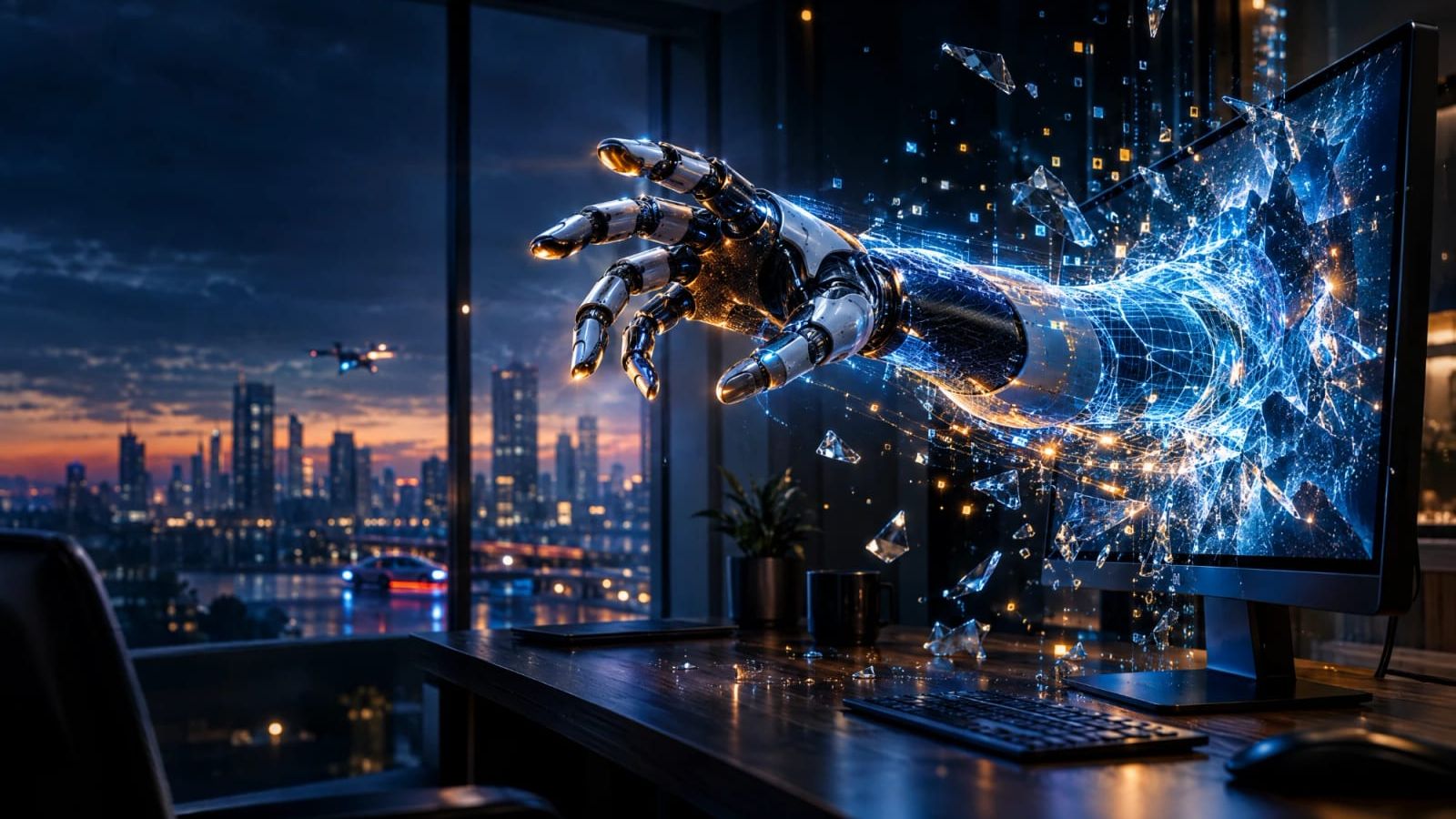
We Are Preparing for Yesterday's AI Revolution
Walk into almost any city hall or corporate headquarters and you will find serious people working through hard questions about generative AI. Which tools are approved. What data can be shared. Who checks the output. What to do when it is confidently wrong.
Those are the right questions. They are also, increasingly, questions about the last wave.
Look at how AI has evolved. First it generated information. Then it began taking actions inside software. Now it is gaining the ability to act in the physical world. Each step raises the cost of weak governance and poorly designed processes.
We are still figuring out how to govern AI that writes an email. We are about to confront AI that drives vehicles, operates equipment, and works alongside the public. My argument is that this next step could prove more consequential than generative AI, and that our institutions, government above all, are not preparing for it.
The Machines Are Already Working
This is not science fiction. Waymo now averages about 500,000 paid driverless rides a week across 15 U.S. cities. Komatsu commissioned its 1,000th autonomous ultra-class haul truck in April. Amazon operates more than one million warehouse robots.
None of these is a humanoid. The machines doing the most useful work today are specialized systems built for one job, many relying more on careful engineering than on the newest AI models.
But the hardware economics are shifting fast. Unitree, the Chinese manufacturer that went public this year, disclosed that the average price of the humanoids it sold fell from about $85,000 in 2023 to about $25,000 in 2025, as reported by Rest of World. Its smallest model launched at about $5,900.
A humanoid robot can now be bought for less than the price of a used car. That doesn't mean you have bought an employee. Unitree's average fell partly because buyers shifted to smaller models, and most of its sales went to research and education. These machines still need substantial development and supervision. A humanoid doing real commercial work, such as Agility Robotics' Digit, costs roughly $100,000 a year as a service.
What matters is the direction. Hardware once confined to specialized labs is now within reach of universities, developers, and small companies, and experimentation is how industries find the applications that eventually pay.
What the Next Decade Could Look Like
Picture a city where machines routinely inspect bridges and pipes, deliver materials to job sites, keep parks and facilities clean, move supplies through hospitals, and work alongside people in plants and warehouses. None of it requires a robot that looks like us.
Think of it in three planning horizons, not promises:
Today: specialized robots completing defined tasks in controlled or bounded environments.
The next three to five years: expanding applications and more capable mobile robots that can handle a wider variety of tasks.
Longer term: potentially general-purpose robots that can do many kinds of physical work.
The early wave will be less spectacular than a humanoid on stage. It may be far more economically meaningful.
Why This Could Be Bigger Than the LLM Revolution
Generative AI changed the economics of intelligence. Physical AI could change the economics of labor.
The real potential isn't that robots might replace people in particular jobs. It's that physical AI could loosen three constraints that have shaped economic activity for centuries.
Labor availability. Businesses and governments are limited by how many people they can find to drive, lift, inspect, repair, and build. Autonomous systems could make many activities less dependent on that supply.
Cost of production. As capable machines get cheaper, tasks that were never worth automating start to pencil out.
Operating capacity. Machines can work longer hours with different staffing, provided the maintenance and supervision economics work.
The effects compound. Imagine if it became economical to inspect every mile of roadway and water main several times a year instead of once a decade. Imagine manufacturers choosing locations based on energy costs, supply chains, and proximity to customers, with labor availability a smaller factor than it is today. Entire categories of economic activity could become cheaper, changing where companies make things, how infrastructure is maintained, and which communities prosper.
These are scenarios, not demonstrated outcomes. General-purpose robots may be years or decades from widespread use. But the stakes are also different in kind. A flawed memo can be corrected. A machine that misjudges a pedestrian causes injury. GM's Cruise lost its California permits after one of its driverless cars dragged a pedestrian, already struck by another vehicle, in October 2023. A year later GM stopped funding the robotaxi business.
We Weren't Ready for the First Wave
Institutions have already struggled with far simpler technology. When ICMA surveyed 635 local government officials in spring 2024, only 9 percent reported an organization-wide AI policy, and 4.5 percent organization-wide AI training. Many have moved since, but that was the starting point.
New York City's MyCity chatbot told business owners they could take workers' tips and refuse cash, both illegal, as The Markup found. Journalists, not the city, discovered the errors. Chicago spent $33 million on gunshot detection before its inspector general found that fewer than one in ten alerts led to evidence of a gun crime.
These cases don't prove government fails at technology; many agencies do impressive work with very little. They show a pattern: systems bought before anyone could validate them, with problems surfacing after the public found them. The issue isn't the people. It's capacity, incentives, and access to expertise.
If we have struggled to validate software that provides information, how will we validate machines acting in the physical world?
Responsibility Without Authority
Businesses get to decide whether to adopt physical AI. Governments will have to deal with it whether they adopt it or not.
Government will be expected to manage the consequences of a technological transformation it neither controls nor fully understands. That is the heart of the problem.
A city manager may have no authority to stop a state-authorized autonomous vehicle company from operating locally, yet city crews must respond when one of its vehicles blocks an ambulance. An elected official has no say over a manufacturer's automation decisions but will be expected to answer when the local plant needs half the workers it used to.
Workforce is where the mismatch may hurt most. The research on industrial robots suggests that automation often shows up first as fewer entry-level hires, not layoffs. That raises a question every employer should be asking: if the routine physical tasks that trained new workers are automated, how does the next generation become technicians, supervisors, and managers? Government faces it twice: for its own workforce, where succession is already strained, and for the communities whose career ladders it is expected to protect.
Some governments are investing heavily. China has made embodied AI a national priority. The European Union has built the most comprehensive legal framework anywhere. In the United States, the FCC this summer added foreign-produced ground robots to its Covered List, barring new models from authorization without federal approval. That will shape what public agencies can buy.
But investment and regulation are outrunning institutional capacity. Responsibility sits locally. Authority, expertise, and resources mostly sit somewhere else.
We Have Seen This Movie Before
San Diego's smart streetlights are the example I return to most often. The program was approved in 2016 to save energy and capture traffic and air-quality data. Police came to treat the cameras as an investigative tool, without proper public notice or oversight. After public outcry, the city adopted a surveillance ordinance which governed how this technology was used. From that experience, the lesson I draw isn't about any single decision. It's that technology can begin as an infrastructure project and end up raising governance questions nobody asked at purchase. Its uses evolved much faster than the framework governing it.
That lesson matters even more for physical AI. A machine bought to inspect pipes or patrol a garage can gain new capabilities overnight through a software update. If the governance only covers what the machine did on the day it was purchased, it is already out of date.
We have spent decades learning that buying technology is easier than changing organizations. Physical AI is about to make that lesson far more expensive. Corporate AI is relearning it now: in McKinsey's 2026 survey, nearly nine in ten respondents reported regular AI use, but only 37 percent attributed any EBIT impact to it.
A Test of Organizational Maturity
The transition to physical AI is ultimately a test of organizational maturity, not technological sophistication.
Enterprise AI deployments are already revealing how many organizations run on undocumented processes, informal workarounds, fragmented systems, and knowledge held by a few people. Put AI into that environment and it doesn't fix the problems. It scales them. If your processes are broken, AI will help you execute them faster. If your safety practices are weak, physical AI can turn those weaknesses into something far more dangerous.
An organization that struggles to protect workers around conventional forklifts will not suddenly master a floor shared by people and robots. Robotics doesn't remove the need for safety engineering. It demands new practices and makes existing ones more important.
To be clear, physical AI can also make work much safer, by taking people out of trenches, confined spaces, and traffic lanes. Organizations don't need perfection before they pilot. They need validated processes, operational discipline, safety engineering, and clear responsibility for failures.
Before we can safely put robots to work beside people, we need to understand how people actually work, including the shortcuts, workarounds, and undocumented decisions that keep our organizations running today.
Stop Solving the Same Problem Thousands of Times
There is no shortage of AI guidance. What is scarce is support that carries agencies through implementation and independently evaluates the results.
The deeper problem is structural. Thousands of cities, counties, utilities, and transit agencies will confront substantially the same technologies, risks, and procurement decisions, yet our institutional model asks each to solve them alone, at its own expense.
Independent partners can help change that: universities, nonprofit technology organizations, professional associations, and philanthropy working together around three principles.
Independent evidence. Evaluations of technologies that don't depend on vendor marketing, done by people free to publish unfavorable findings and recommend against deployment.
Shared implementation. Common testing protocols, pilot designs, contract terms, and safety practices, so no agency has to rediscover what others already learned.
Public-interest accountability. Published results, including failures, that set shared expectations for performance and reliability.
This is not a substitute for regulators, public agencies, or safety certification authorities. It is the shared capacity those institutions often lack. The constraints are real: independent testing is expensive, evaluator liability is unresolved, and sustainable funding is hard. But the alternative is a choice between trusting vendor claims and refusing to innovate, and government deserves better than that.
The Window to Prepare Is Now
No one can say when general-purpose robots will be everywhere. Some companies will fail, some breakthroughs will take longer than promised, and some applications will never pay. The institutional challenge is here either way, because autonomy is already moving from software into the world.
We have an opportunity we didn't have when generative AI exploded into public consciousness: time to prepare.
We can use it to redesign broken processes, strengthen safety, prepare workers, and build the independent institutions governments need to evaluate and adopt new technologies responsibly.
Or we can wait until the technology is operating on our streets, in our workplaces, and throughout our communities before asking whether we are ready.
Based on our experience with previous technology transitions, I have a pretty good idea which path we are on.
I would very much like to be wrong.
Sources
- Waymo: TechCrunch, Sept. 24, 2026
- Komatsu 1,000th autonomous haul truck: Komatsu, Apr. 22, 2026
- Amazon one million robots: TechCrunch, July 1, 2025
- Unitree prices and sales mix: Rest of World, Mar. 31, 2026
- Unitree R1 launch price: Business Standard, July 25, 2025
- Agility Robotics pricing from S-4: The Robot Report, Sept. 7, 2026
- ICMA, AI in Local Government: 2024 Survey Results
- NYC MyCity chatbot: The Markup, Jan. 30, 2026
- Chicago OIG ShotSpotter review: WTTW, Aug. 24, 2021
- FCC robot Covered List: Sidley Austin, Aug. 2026
- San Diego smart streetlights: Voice of San Diego
- McKinsey, The State of AI in 2026
- Robots and entry-level hiring: Dauth et al., Journal of the European Economic Association, 2021