Article · Writing
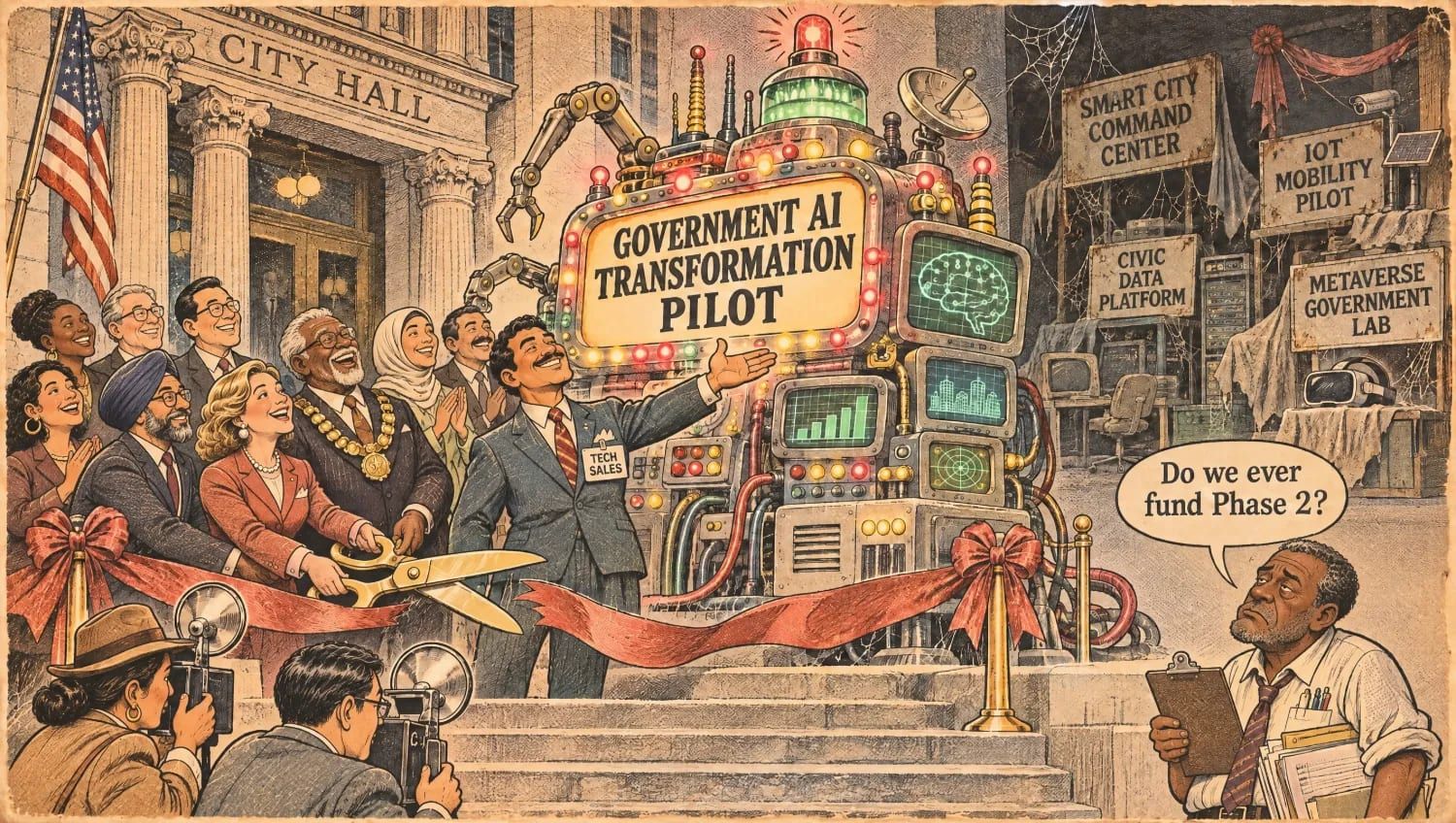
Government AI Is at Risk of Becoming Smart Cities 2.0
Nearly two decades after Smart Cities, governments are embracing another technological revolution. Have we learned enough from the last one?
On November 6, 2008, in the middle of a global financial crisis, IBM CEO Sam Palmisano addressed the Council on Foreign Relations in New York.
His speech, A Smarter Planet: The Next Leadership Agenda, presented a vision of a world where increasingly connected and intelligent systems could transform everything from transportation and energy to healthcare and government.
The timing was remarkable. Governments were facing enormous financial pressures, infrastructure challenges and growing demands for public services. Technology offered a compelling vision of how they could do more with less.
By January 2010, IBM reported having conducted nearly 100 Smarter Cities conferences attended by more than 2,000 civic leaders.
An industry was taking shape.
Fast forward to August 2025.
The U.S. General Services Administration announced agreements with leading artificial intelligence companies that made powerful AI tools available to participating federal agencies at exceptionally low introductory prices. OpenAI offered ChatGPT Enterprise for $1 per agency for a year.
Once again, governments were facing financial pressures, workforce challenges and increasing demands for public services.
Once again, technology companies were offering a compelling vision of transformation.
And once again, I found myself wondering whether governments were asking the right questions.
I've seen this movie before
Having spent much of my career in local government, including serving as a senior municipal executive in San Diego, and subsequently working in the technology industry, I've had the opportunity to see government technology adoption from both sides of the table.
I believe deeply in the potential of technology to improve government. I also believe artificial intelligence represents one of the most significant opportunities to transform public administration in decades.
But believing in the potential of technology is different from believing that acquiring technology will automatically produce better outcomes.
That distinction is one of the most important lessons from the Smart Cities movement.
And it is a lesson we risk forgetting.
Who decided what it meant to be a smart city?
The idea of using technology and data to improve cities was not new in 2008.
Decades earlier, governments were already using computers to analyze neighborhood conditions, model transportation systems, understand economic trends and improve urban planning.
Amsterdam launched its Digital City initiative in 1994. Stockholm decided to pursue a congestion pricing trial in 2003. South Korea was developing national strategies for digitally connected communities before IBM launched Smarter Planet.
Governments had legitimate problems and were actively exploring technology to solve them.
What changed in the late 2000s was the commercialization of the concept.
IBM, Cisco, Siemens, General Electric, Microsoft and other companies helped establish a new vision of what a modern city should look like.
Smart streetlights. Connected infrastructure. Intelligent transportation systems. Urban command centers. Sensor networks. Integrated data platforms.
Entire conferences, industry associations, consulting practices and corporate strategies emerged around the concept.
In 2014, researchers Ola Söderström, Till Paasche and Francisco Klauser published an academic paper titled Smart Cities as Corporate Storytelling, examining how IBM positioned itself as an essential participant in urban technology transformation.
Subsequent research by Jathan Sadowski and Roy Bendor, published as Selling Smartness, identified a recurring narrative in IBM and Cisco's promotional materials: cities were facing increasingly complex crises, and technology offered a path to overcoming them.
The important distinction is that technology vendors did not necessarily dictate what governments purchased.
But they played an enormously influential role in defining what governments believed they should aspire to become.
Governments had their own incentives, too. Elected officials wanted to demonstrate innovation. Executives wanted to improve services. Federal agencies offered grants. Cities competed for recognition, investment and talent.
The result was an ecosystem in which commercial and governmental incentives could align around acquiring technology without necessarily aligning around how to realize its long-term value.
What did we actually accomplish?
The Smart Cities movement produced legitimate successes.
Some cities improved transportation systems, reduced energy consumption, expanded digital connectivity and enhanced emergency response capabilities.
But the historical record also reveals a more complicated picture.
In 2016, Columbus, Ohio, won the U.S. Department of Transportation's Smart City Challenge. The city originally proposed 15 projects and ultimately delivered eight.
Adoption varied substantially across those projects. Some applications attracted tens of thousands of users, while others struggled to generate demand. In its 2021 final report, the city indicated that five projects would continue beyond the grant period.
The experience illustrates both the opportunities and limitations of grant-funded innovation.
Then there is the question of what happens when technology vendors change direction.
In April 2021, Cisco ended sales of its Kinetic for Cities platform. Its official end-of-sale announcement indicated that no replacement was available for the affected products at the time.
For governments, whose infrastructure and operating responsibilities frequently span decades, the commercial lifecycle of a technology product can be considerably shorter than the institutional lifecycle of the service it supports.
Here in San Diego, the smart streetlight experience also demonstrated that technological capabilities, operational value, public trust and political support are not necessarily aligned.
A technology can provide a useful capability and still encounter significant challenges because of how it is governed, communicated and incorporated into government operations.
None of this means the Smart Cities movement was a failure.
It means that deploying technology was not, by itself, sufficient to deliver the transformation that had been promised.
Same industry. New technology.
Today, much of the conversation around government innovation has shifted toward artificial intelligence.
Instead of smart sensors, we are talking about AI agents.
Instead of urban command centers, we are talking about AI orchestration platforms.
Instead of smart city strategies, we are developing enterprise AI strategies.
Instead of counting connected devices, we are counting AI use cases.
Even some of the same companies and conferences are participating in the transition.
In 2018, Mastercard launched its City Possible initiative at Smart City Expo World Congress in Barcelona, with San Diego and Kansas City among its founding members.
In September 2025, Mastercard published an article titled Civic Intelligence: How AI Is Powering Smarter Cities.
There is nothing inherently wrong with this evolution. Technology companies should innovate, and governments should take advantage of emerging capabilities.
But the familiar pattern raises questions worth asking.
Are governments developing AI strategies because they have identified specific operational challenges that AI can help solve?
Or are they developing AI strategies because artificial intelligence has become something every government is expected to have a strategy for?
Those are fundamentally different starting points.
Are we measuring adoption or transformation?
In July 2025, the U.S. Government Accountability Office reported that across 11 selected federal agencies, identified AI use cases increased from 571 in 2023 to 1,110 in 2024.
Generative AI use cases increased from 32 to 282.
That is remarkable growth.
But it tells us relatively little about whether those agencies are becoming more effective.
Similarly, a UK government trial involving approximately 20,000 employees found that Microsoft Copilot users reported saving an average of 26 minutes per day.
That is encouraging.
But what happened to those 26 minutes?
Did permit applications get processed faster?
Did residents receive better customer service?
Did employees reduce existing backlogs?
Did government increase its capacity to deliver services without increasing expenditures?
Did the quality of government decision-making improve?
Individual productivity is valuable. But individual productivity and institutional performance are not the same thing.
Governments exist to deliver public value, not simply to make employees more efficient at completing individual tasks.
If we measure AI adoption primarily through licenses purchased, use cases identified, pilots launched and minutes saved, we risk confusing activity with progress.
We have made that mistake before.
AI is different, and that matters
The comparison between smart cities and artificial intelligence is not perfect.
Deploying thousands of sensors across a city requires physical infrastructure, capital investment, installation and maintenance.
Deploying an AI tool can be as simple as purchasing a software subscription.
AI can also address existing government workflows in ways that many earlier smart city technologies could not.
Government employees write reports, analyze documents, respond to residents, review applications, conduct research and process information every day.
AI has legitimate applications across all these activities.
Governments can experiment more quickly, at lower initial costs and with fewer physical infrastructure requirements.
That is an enormous advantage.
It is also a potential risk.
The speed at which governments can acquire AI capabilities may considerably exceed the speed at which they can develop the institutional capabilities necessary to use them effectively.
An organization can distribute AI licenses to thousands of employees without changing its operating model, improving its data architecture, redesigning a single business process or establishing how AI will contribute to its strategic objectives.
It can acquire the appearance of transformation without undertaking the difficult work of transformation itself.
The institutional capability problem
In its March 2024 report on the use of artificial intelligence in government, the UK's National Audit Office identified an important distinction.
Realizing large-scale benefits from AI would require substantial changes to business processes and the government workforce, not simply the adoption of new technology.
This gets to the heart of the issue.
What if the biggest challenge facing government AI adoption isn't access to artificial intelligence?
What if it is the ability of government institutions to effectively incorporate artificial intelligence into how they operate?
Consider the organizational capabilities required to do this well:
- Executive leadership capable of defining strategic outcomes.
- Employees with the skills to use and evaluate AI.
- Well-governed, accessible and reliable data.
- An enterprise technology architecture that supports integration.
- Procurement practices that preserve flexibility and independence.
- Operational leaders who understand how to redesign workflows.
- Governance mechanisms that maintain accountability and public trust.
- Performance measurement focused on actual public outcomes.
These are not things governments can simply purchase from an AI vendor.
Technology companies can help develop these capabilities. Consultants can provide valuable expertise. But ultimately, government must own its transformation.
We have an opportunity to get this right
This article is the first in a ten-part series examining the history of the Smart Cities movement, its parallels with government AI adoption and what governments can do differently this time.
Over the course of this series, I'll explore:
- Who really defined the Smart Cities movement.
- What happens when technology goes looking for a problem.
- The long-term implications of exceptionally inexpensive AI offerings.
- What smart streetlights can teach us about governing AI agents.
- Why institutional capability may be more important than technological capability.
- Why government innovation pilots struggle to become permanent operations.
- How industry conferences have evolved from smart cities to AI.
- Why saving employees time is not a government AI strategy.
- What an effective government AI transformation operating model should actually look like.
My objective is not to discourage government technology adoption. Quite the opposite.
I want governments to realize the extraordinary potential of artificial intelligence.
But doing so requires us to recognize that technology acquisition and organizational transformation are two very different things.
The next time someone presents an AI initiative to your executive team, ask three questions:
- What specific government outcome are we trying to improve?
- Who within the organization is accountable for achieving that outcome?
- What will we change about how we operate to make that improvement possible?
If those questions cannot be answered, perhaps the organization isn't ready to select its AI solution.
The greatest risk facing government AI adoption may not be that artificial intelligence fails.
It may be that governments successfully acquire some of the most powerful technology ever developed, without meaningfully changing how government works.
We've had nearly two decades to learn that lesson.
Let's not spend another two decades learning it again.
Part 1 of 10 | From Smart Cities to Artificial Intelligence
Disclosure: I am a former municipal government executive and a technology company co-founder. My perspective is informed by experience in both government operations and the development of technology for public-sector organizations.