Article · Writing
AI Should Be Killing Vendor Lock-In. Instead, We're Building a New Generation of It.
Faster software development changes the build-versus-buy math. The risk is that AI recreates the same dependencies, only deeper.
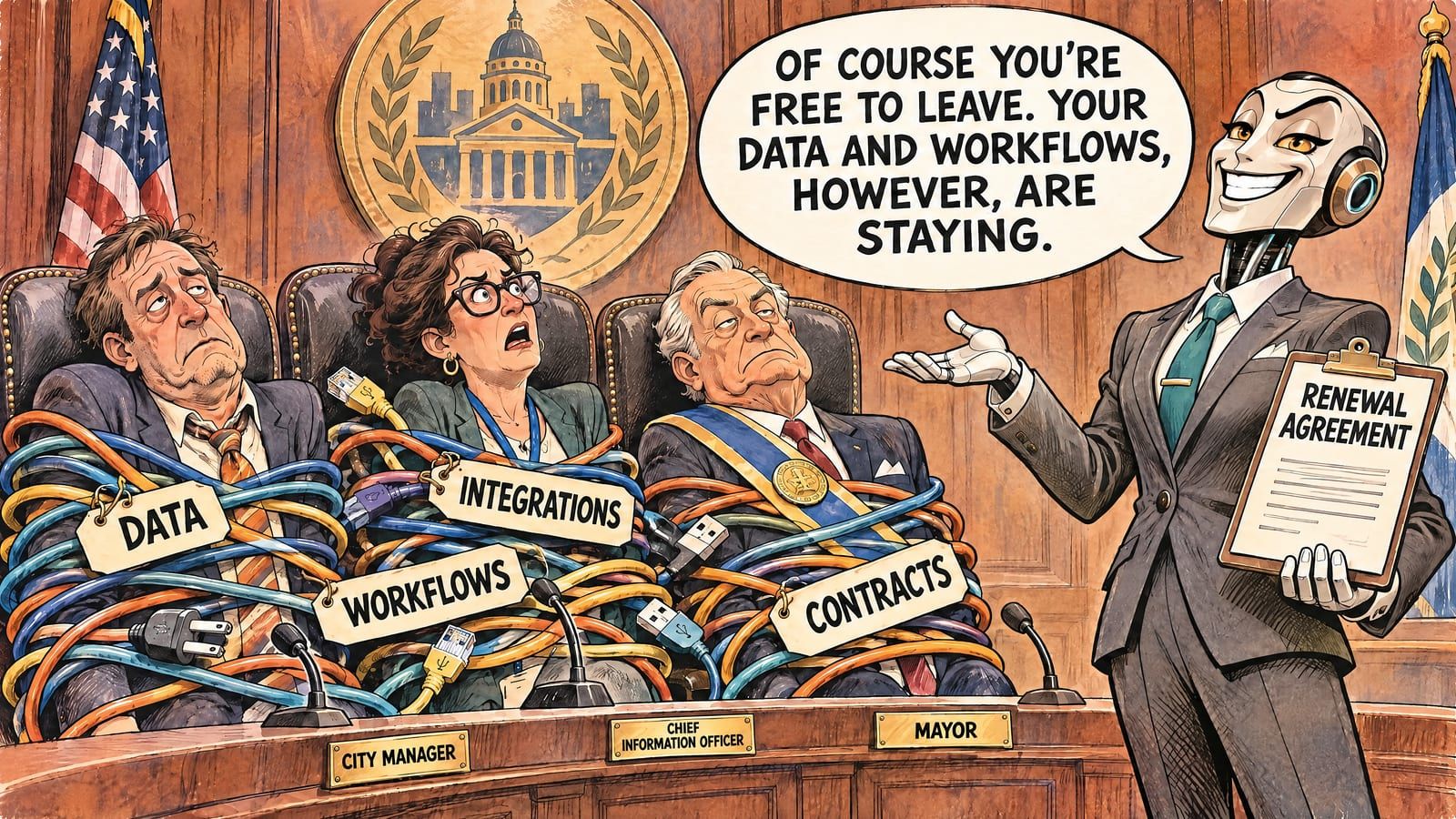
A recent conversation with David Graham at the City of Chula Vista got me thinking about a problem we've tolerated in enterprise technology for far too long. David is one of the most innovative people I know in local government. We were discussing Chula Vista's journey into enterprise AI, and I kept coming back to a question that I think every organization should be asking right now: Are we building lasting AI capabilities, or are we just buying the next generation of technology dependencies? It's not an academic question.
Chula Vista recently adopted a policy governing AI in city operations. That's an important part of responsible adoption. But as governments move from experimenting with AI to deploying it across their organizations, they face another set of decisions that may prove just as consequential. Who controls the technology? Who owns what gets built? And what happens when a better, cheaper, or more capable alternative comes along?
Having spent much of my career in local government leadership, followed by years working in private-sector technology and organizational transformation, I've seen how these decisions play out. And I'm increasingly convinced we're approaching a critical moment. AI should be making organizations less dependent on technology vendors. Instead, we're at risk of recreating the same dependencies with a much more sophisticated set of tools.
Faster software development changes everything. Or does it?
Around the same time as my conversation with David, my good friend and former City of San Diego colleague Almis Udrys joined Concourse, an emerging technology company doing some genuinely interesting work in government software. Almis has spent much of his career pushing government to work smarter, so his move caught my attention. As I learned more about Concourse's approach, I became increasingly interested in what it represents.
The company uses AI-assisted engineering to develop customized government software far faster than traditional development approaches. Its work with Oklahoma, including a new state spending transparency database, offers a concrete example of the kinds of applications it is delivering. I find this exciting. For decades, one of the strongest arguments for buying commercial software has been the cost and complexity of building something yourself. Custom development could require large teams, lengthy implementations, and substantial financial commitments. AI is challenging that assumption.
What once required a large development team and a lengthy project may increasingly be achievable with a much smaller team in a fraction of the time. That's potentially transformative for government. But there's an important distinction that I don't think gets nearly enough attention. Building something customized for a customer is not the same as building something the customer controls.
Concourse is actually an interesting illustration of this distinction. Its published standard platform terms establish customer ownership of data and AI-generated output while licensing access to its underlying proprietary platform. Separately negotiated development arrangements may provide different rights. There's nothing inherently wrong with that model. Proprietary software can deliver tremendous value, and Concourse deserves credit for challenging how quickly government software can be delivered. But its approach raises a broader question for the entire industry: If we're going to reinvent how software gets built, shouldn't we also rethink who ultimately controls it?
The real cost of vendor lock-in isn't the subscription
Organizations rarely become trapped by a technology vendor the day they sign a contract. It happens gradually. When I was DCOO for the City of San Diego we renewed with a vendor on a multi-year permitting software contract knowing we wanted to switch but it would take us a few years to get ready to do so. Your data accumulates in the vendor's system. Your staff learn its workflows. You invest in integrations, customizations, and processes designed around how that particular product operates. Eventually, the decision is no longer whether the vendor offers the best product at the best price. It's whether you can afford the disruption of leaving.
I've seen versions of this dynamic throughout my career. And while it happens in the private sector too, government faces some particularly difficult constraints. A private company can often make a technology change through an executive decision, subject to its own governance and contractual obligations. For a local government, replacing a major enterprise system can mean securing budget appropriations, navigating a competitive procurement, evaluating proposals, negotiating agreements, obtaining council approval, and managing a politically visible implementation. Then there's the public accountability.
A failed technology implementation isn't just an expensive mistake. It's potentially a public audit, a contentious council hearing, a newspaper headline, and a very difficult conversation about how taxpayer dollars were spent. That scrutiny is appropriate. Public money deserves public accountability. But it also creates a powerful incentive to stay with an underperforming system rather than accept the cost and risk of replacing it. Look at what's happening in San Francisco.
In 2025, the city entered into a $5.9 million agreement with OpenGov for permitting software. In 2026, a proposed extension would have taken the agreement to nearly $39 million over a longer term. Following scrutiny of the procurement and implementation, the Board of Supervisors reduced the agreement to approximately $28 million through 2029, with additional provisions addressing the city's ability to exit if performance falls short. I'm not suggesting OpenGov can't deliver a successful system. The important point is what the debate reveals. Once a government commits to a platform, the cost and disruption of changing direction can become central to whether it continues. That is an extraordinary amount of leverage for any vendor to hold. And it makes the ability to walk away one of the most valuable things a customer can preserve.
AI is changing the build-versus-buy equation
For years, enterprise technology decisions often came down to an uncomfortable choice. Buy commercial software and adapt your operations to the product, or spend substantial money building something tailored to your needs. In my AI Transformation Field Guide, I argue for a more deliberate approach: build, buy, or configure based on the particular capability, economics, and long-term strategic value. AI-assisted software engineering is making that decision much more interesting. A small, capable development team can now accomplish work that historically demanded far more resources. Reusable frameworks, increasingly capable coding agents, and access to powerful AI models are changing the economics of custom development. That doesn't mean software is suddenly free.
Someone still needs to design the system, test it, secure it, integrate it, maintain it, and take responsibility when something breaks. And a poorly managed custom application can become its own form of vendor lock-in, particularly when only one developer understands how it works. But the cost of developing the first usable version of an application is increasingly different from what it was even a few years ago. That opens possibilities that weren't practical before.
A city might commission a specialized reporting system, automate a department's document-intensive workflows, or develop an AI assistant that works across existing government applications without replacing all those systems. And if the right contractual and technical decisions are made, that capability could remain under the government's control, even if the original development partner moves on. I'm not suggesting every city should build its own financial management system or become a software company. I'm suggesting we should stop assuming that renting every important technology capability from a proprietary vendor is the only realistic choice.
The next generation of lock-in may be even harder to escape
Here's where I think the AI industry needs to be challenged. We are building an entirely new layer of enterprise technology, and many of the same dynamics that created traditional software lock-in are emerging all over again. Only now the dependencies go deeper. It's no longer just your data, software licenses, and integrations. It's the AI models your applications depend on. The proprietary agent frameworks running your workflows. The prompts, configurations, and institutional knowledge embedded in those systems. The infrastructure processing every request and the consumption charges associated with using it.
Imagine investing heavily in an enterprise AI platform, embedding it in dozens of departmental processes, and training hundreds of employees around it. Then another AI provider releases a dramatically better model. Or your existing provider changes its pricing. Or a new approach makes the original architecture obsolete. How easily can you change? If the answer is that you need to rebuild your applications, renegotiate a major enterprise contract, or start your implementation over, you haven't created much flexibility. You've simply traded one kind of dependency for another.
In my Field Guide, I emphasize multi-model strategies and AI gateways precisely because organizations should preserve meaningful choices about the technology they use. Open standards such as the Model Context Protocol can help make integrations more portable. Model gateways can separate applications from individual AI providers. And having your own evaluation processes allows you to determine whether an alternative model can actually perform the work you need. None of this makes switching providers effortless. But there's an enormous difference between a system designed to accommodate change and one that assumes you'll never leave. Flexibility isn't something you get because a vendor says its platform is open. It's something you have to design, negotiate, and test.
You don't have to own everything. You need to own your ability to leave.
I don't believe organizations should build everything themselves. Commercial software has real advantages. Vendors spread development costs across customers, maintain specialized functionality, handle upgrades, and provide expertise that many organizations cannot reasonably replicate. Sometimes a subscription is absolutely the smartest decision. But there is a difference between choosing to rely on a vendor and having no realistic alternative. The objective shouldn't be complete technological self-sufficiency. It should be owning your ability to leave.
That means asking a different set of questions before signing an enterprise AI agreement:
- Can we take our data, workflows, and configurations with us in formats we can actually use?
- Could another engineering firm maintain or extend the applications we've paid to develop?
- Can we change AI models or infrastructure providers without rebuilding everything?
- Do we have contractual exit rights, technical documentation, and a realistic understanding of what it would cost to transition?
There are emerging approaches worth watching.
National AI Lab and ibl.ai, for example, advertise models that give customers access to code and greater deployment control. Those promises still need to be verified in actual contracts, but the direction is interesting. And governments themselves are demonstrating alternatives. New Jersey rebuilt its statewide AI assistant using the open-source LibreChat framework, with a five-person product and engineering team. More than 20,000 state employees have used the system, and the state reports usage costs below $1 per user per month compared with roughly $20 for commercial licenses.
Those reported costs aren't a complete accounting of development and maintenance. But the example demonstrates something important. Government isn't limited to choosing between expensive custom software and permanent dependence on commercial platforms. There are increasingly viable options in between. And the more governments experiment with them, the more leverage they will have with every technology provider.
It's time to change what we demand from technology vendors
I want technology companies to succeed. I want startups like Concourse to challenge established vendors, drive down development costs, and deliver better software to government. I also want governments to stop treating vendor dependence as an unavoidable cost of modernization. These ideas aren't in conflict.
In fact, I think the next generation of great enterprise technology companies should compete on how much value they deliver, not how difficult they make it for customers to leave. A vendor that knows its customers can walk away has a powerful incentive to keep innovating, improving its product, and offering competitive pricing. That's how healthy markets are supposed to work. Government executives have a role to play too.
Stop evaluating enterprise AI solutions solely on their features, implementation timelines, and subscription prices. Start asking about architecture, portability, ownership rights, and exit costs before procurement decisions become permanent dependencies. And let's stop confusing buying access to AI with building an organizational AI capability. They're not the same thing. Right now, companies and governments are making technology decisions that could define their options for the next decade.
We have an opportunity to build systems that are more flexible, more competitive, and more responsive to the organizations using them. Or we can build another generation of expensive platforms that customers spend years trying to escape. AI should give organizations more freedom, not fewer choices. And if AI is making software easier to build, the hardest part of using it shouldn't be escaping the company that sold it to you.