Article · Writing
Why I Created The AI Transformation Field Guide
It started as my own notes for staying current. It became a living document for the people who run institutions and the AI systems working alongside them.
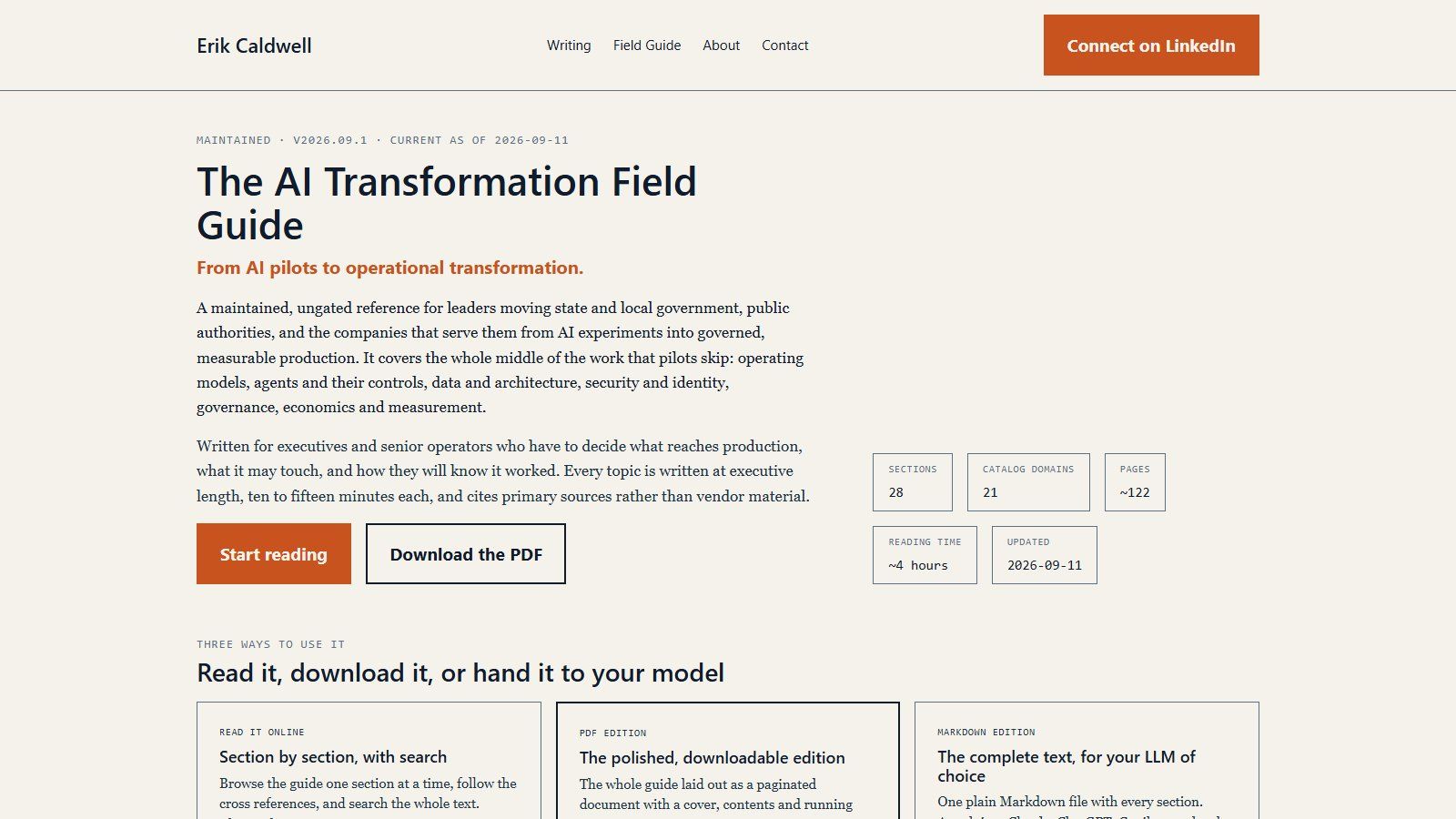
AI is moving faster than our traditional ways of learning about technology can keep up.
That is ultimately why I created The AI Transformation Field Guide.
It did not start as a book or a publishing project. It started as a tool for me.
Every few months, I found myself going back through the latest research, technical documentation, practitioner writing, and case studies around enterprise AI deployment. I was trying to answer a practical question:
What do I need to understand right now to help an organization move AI from experimentation into safe, useful, production systems?
The answer kept changing.
The fundamentals of enterprise transformation still matter, but the technology underneath them is evolving at an extraordinary pace. New capabilities appear. Old constraints disappear. Practices that seemed sensible six months earlier need to be reconsidered.
So I kept updating my notes.
At first they were simply a way to stay current on topics like governance, architecture, security, evaluation, workflow redesign, and organizational change. Then new issues kept emerging, particularly around agents, context, model orchestration, AI infrastructure, and the changing nature of software development.
Over time, the notes became more structured. I rewrote sections, added frameworks, connected ideas, and came back periodically to challenge what I had written.
Eventually, it started to look like a book.
But there was another reason I thought the material might be useful beyond my own work.
The 90-day problem
One of the hardest parts of being an AI practitioner today is explaining to other leaders that something you told them was true 90 days ago may no longer be true today.
That can be a difficult message to deliver.
Executives reasonably expect expert advice to have some durability. But in AI, a capability that once required custom development can suddenly become standard. A model that was too expensive or unreliable can become practical. An architecture decision that made perfect sense a few months earlier can need to be reconsidered.
The technology changes, but executives still have to make decisions.
They have to decide where to invest, what risks to accept, what capabilities to build, how to organize teams, and when an experiment is ready for production.
They do not need to become AI engineers.
They do need a current enough understanding of the technology to ask the right questions and recognize when the assumptions behind an earlier decision have changed.
I realized the material I was building for myself could also help close that gap.
The Field Guide became an attempt to explain the parts of AI transformation that matter most to people responsible for deploying it inside real organizations, without requiring them to chase every new model release or product announcement.
Why I did not turn it into a book
At one point, I seriously considered recasting the material as a traditional book.
Then the obvious problem became hard to ignore.
By the time I rewrote it as a manuscript, edited it, published it, and got it into readers' hands, parts of it would already be outdated.
That seemed like exactly the wrong format for the subject.
So instead of treating the Field Guide as something that could ever really be finished, I decided to publish it as a living document on my personal website.
There is no final edition.
As the technology changes, I can update the guide. As practices mature, I can revise recommendations. As new issues become important, I can add them. And when practitioners send me research, examples, disagreements, or things I have missed, those can shape future versions.
That feels much closer to how knowledge about AI needs to work right now.
Publishing for humans and AI
I also wanted to think differently about how people will use the material.
I do not expect everyone to read more than 160 pages from beginning to end.
Increasingly, people work with information alongside AI systems. They may attach a document to ChatGPT, Claude, Copilot, or another model and ask questions against it. They may use an agent to monitor changes or retrieve relevant sections when they need them.
So I wanted the Field Guide to work in that environment too.
In addition to the website, I provide the complete guide as a plain Markdown file that can be attached directly to an LLM. I also added RSS so people and AI-enabled workflows can discover when the material changes.
Those choices are intentional.
I think publishing itself is beginning to change.
Knowledge increasingly needs to be useful not only to the person reading it directly, but also to the AI systems working alongside that person. That means information should be structured, portable, easy to update, and easy for machines to work with.
In that sense, the Field Guide is also a small experiment in AI-native publishing.
Why I keep maintaining it
There is another benefit I did not fully appreciate when I started.
Writing is a useful test of whether you actually understand something.
It is easy to read about a new technology and feel like you understand it. Writing forces you to decide what matters, what is durable, what is mostly hype, and how the technology connects to the reality of running an organization.
Then, a few months later, maintaining the guide forces another question:
Is this still true?
That discipline has become one of the main ways I keep myself current.
The irony is that I originally created the Field Guide because I was worried about falling behind. Maintaining it has become one of the best tools I have for making sure I do not.
I do not consider this the definitive book on AI transformation. I am not sure such a thing can exist while the field is changing this quickly.
It is a working guide for a field that is still being invented.
The goal is to help practitioners orient themselves, help executives ask better questions, and help organizations understand what it actually takes to move from an impressive AI demonstration to a capability that survives contact with production.
I have found it useful.
I hope you do too.
And if you find something I have missed, something that has changed, or something you think I have wrong, send it my way.
There will always be another edition.