Article · Writing
The Data Center Backlash Is a Warning About AI's Political Future
Voters backed limits on data centers in 40 of 41 local measures. We may be building a politics where opposing AI is easier than preparing people for it.
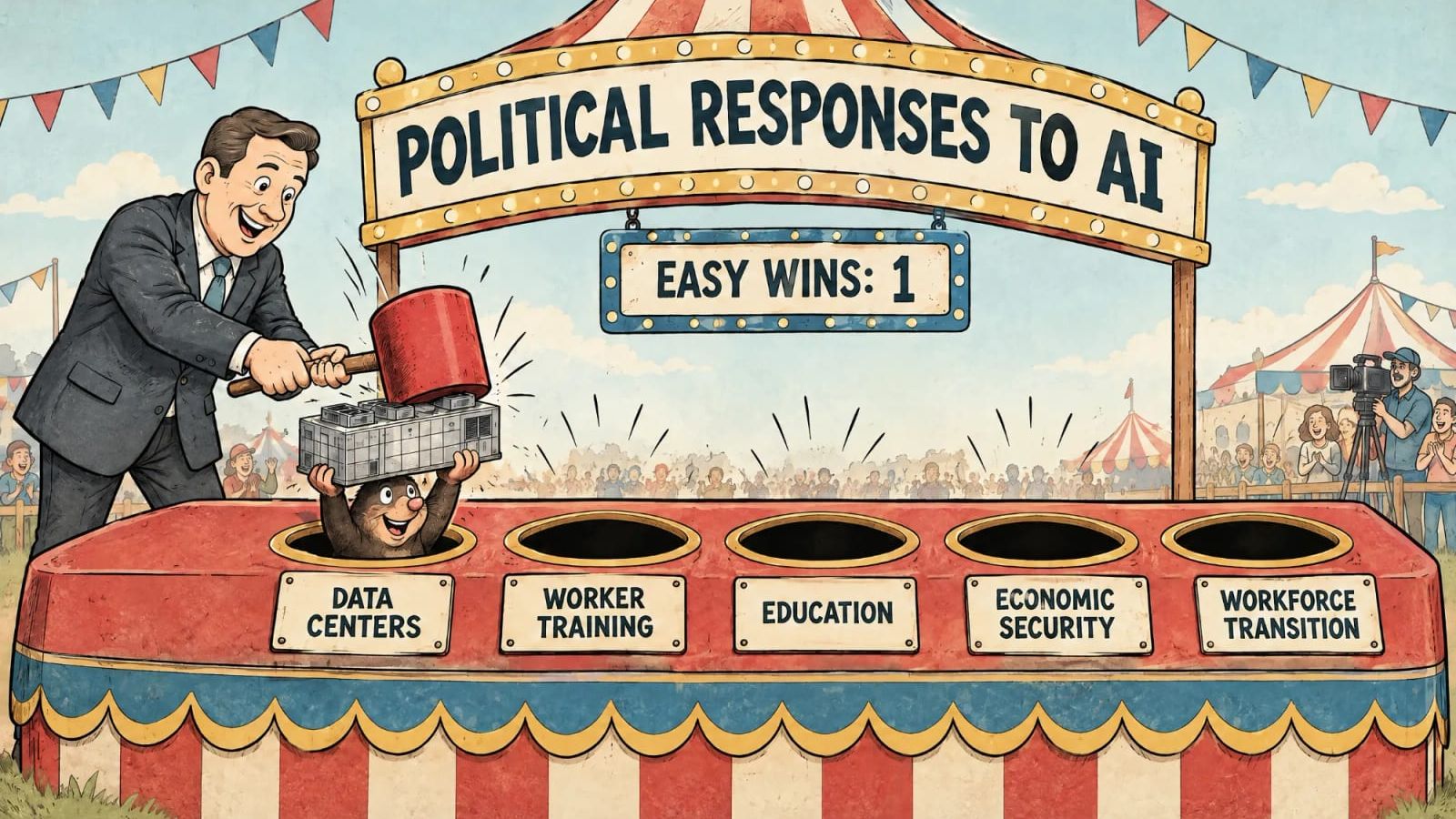
We're creating a political environment where opposing AI may become easier than doing the difficult work of preparing people for it.
The November 3 election offered an early warning. Across the country, voters favored restrictions on data center development in 40 of 41 local ballot measures, according to Ballotpedia. In Texas, Republican Governor Greg Abbott had already paused certain data center approvals. Democrat Gina Hinojosa, who defeated him, campaigned on an even broader moratorium. The message crosses party lines, even if the intensity of opposition differs.
I wouldn't suggest that data centers decided the Texas election or that these local votes amount to a national referendum on artificial intelligence. The evidence doesn't support either conclusion. But I believe something more consequential is beginning to take shape. Americans are becoming increasingly concerned about the consequences of AI, and our political institutions may be better equipped to restrict its development than to help people navigate the changes it will bring. That should concern anyone who believes in the potential of this technology.
The Data Center Is the Visible Target
Opposition to data centers is real, and many of the concerns are entirely reasonable. A Gallup survey earlier this year found that 71% of Americans oppose construction of an AI data center in their community. That's greater than the 53% who oppose a nearby nuclear power plant. Residents worry about electricity costs, water consumption, environmental impacts, land use, and whether their communities will actually benefit from these enormous investments. These are legitimate issues that deserve serious answers. But the opposition is developing alongside another, potentially more consequential source of uncertainty: What happens to people's livelihoods as AI transforms the economy? We don't yet know the answer.
Research from Stanford has not found widespread, economy-wide employment displacement attributable to AI. It has, however, identified troubling employment patterns among younger workers in occupations highly exposed to the technology, without establishing that AI caused those changes. AI may ultimately create more opportunities than it eliminates. It may make millions of workers more productive, improve public services, and generate entirely new industries. I believe it can. But optimism about the technology isn't a substitute for preparing people for its consequences. And while there's no evidence that fear of job displacement drove the recent data center votes, it would be a mistake to assume these concerns will remain politically separate.
The Political Incentive Problem
Having spent much of my career in local government, I understand the position elected officials find themselves in. Residents are concerned. They want answers. They expect their representatives to do something. And elected officials naturally turn to the tools available to them. A city council can deny a development permit. A county can impose a moratorium. A state legislature can establish restrictions. Sometimes those are exactly the right decisions. But consider what those same institutions cannot easily accomplish.
A city council cannot independently prepare its workforce for a fundamental restructuring of the economy. It cannot determine which occupations AI will transform, coordinate employers across industries, redesign education and workforce development systems, or provide economic security to workers whose skills may become less valuable. Those challenges require coordination across government, industry, labor, education, and philanthropy. They take years to address, involve considerable uncertainty, and rarely produce immediate political victories. Stopping a project is a decision. Preparing a community for economic transformation is a sustained commitment. One is relatively straightforward to explain to voters. The other requires difficult conversations about an uncertain future. That's the political problem.
We risk creating an environment where elected officials receive more immediate political benefit from opposing the visible infrastructure of AI than from undertaking the much harder work of preparing people for the technology itself. This doesn't require cynical politicians or uninformed voters. It's a predictable consequence of how political incentives and institutional authority intersect. And over time, the consequences could extend well beyond data centers. If economic uncertainty increases and people don't see a credible strategy for protecting their opportunities, opposing AI itself may become an increasingly attractive political position. Not because opposition necessarily offers a solution, but because it offers a response.
We've Seen What Happens When We Don't Prepare
Globalization offers an imperfect but important lesson. International trade generated substantial economic benefits, but those benefits were not distributed equally. Research by economists David Autor, David Dorn, and Gordon Hanson documented how communities exposed to Chinese import competition experienced prolonged employment losses and economic disruption. Subsequent research connected trade exposure with political polarization. The lesson isn't that globalization was necessarily a mistake. It's that economic transformations can generate enormous aggregate benefits while imposing concentrated costs on particular workers and communities.
When institutions fail to address those costs, the political consequences can endure long after the economic transformation is underway. AI is different from globalization in important ways. Its effects may be broader, its pace faster, and its potential to complement rather than replace human labor substantially greater. We should be careful about assuming history will repeat itself. But we should be equally careful about assuming that technological progress will automatically translate into broadly shared prosperity. The opportunity this time is that we can prepare before the full consequences become apparent. We don't have to wait for widespread displacement to begin building the institutions, partnerships, and workforce strategies that could help people adapt.
Who Is Preparing America for AI?
Consider the extraordinary effort underway to build the infrastructure for an AI economy. Technology companies are investing enormous sums in computing capacity, energy infrastructure, research, and new products. Governments are debating how to accelerate development, expand electricity generation, and maintain American technological competitiveness. These investments and discussions matter. I want the United States to lead in AI development. But where is the comparable national commitment to preparing the people who will live and work in this new economy? There are encouraging examples.
California has directed state agencies to examine AI's employment effects and protections for displaced workers. The American Federation of Teachers has partnered with technology companies to expand AI training for educators. The National Governors Association has convened states around AI and the future of work. Technology companies and philanthropies are investing in research and workforce initiatives. These are meaningful efforts. What's missing is a sufficiently coordinated approach that connects these activities to the scale of the transformation ahead. We need a shared understanding of how work is changing, which communities and occupations may be most exposed, and how existing education, workforce, and economic development systems should respond. This isn't something technology companies can solve alone. Nor should they be expected to.
Government has a unique responsibility to convene the institutions that must be part of the answer. Employers understand how technology is changing their operations. Labor organizations understand the consequences for workers. Colleges and universities develop the skills that tomorrow's economy will demand. Philanthropy can support experimentation and help scale approaches that work. Government can bring these interests together, establish shared priorities, and ensure that preparation extends beyond the companies and communities best positioned to benefit. That doesn't require a centralized federal plan dictating how AI should develop. It requires leadership, coordination, and a willingness to address difficult questions before they become crises.
The Political Window Is Closing
I am fundamentally optimistic about AI. I believe it can make government more effective, businesses more productive, and people more capable. I've spent much of my career working at the intersection of technology, government, and economic development because I believe innovation can improve lives. But I also know that economic progress and public confidence are not the same thing. People need more than assurances that a new technology will eventually make society wealthier. They want to know what it means for their jobs, their children, their communities, and their ability to build a secure future. If we cannot begin answering those questions, we should not be surprised when political leaders discover that opposing AI is easier than explaining how we intend to prepare for it.
The recent data center backlash is not proof that America is turning against artificial intelligence. It is a warning about what could happen if we fail to lead. We're mobilizing extraordinary resources to build the AI economy. Now we need to demonstrate the same commitment to preparing people to succeed in it. Because if government, industry, labor, education, and philanthropy don't do the difficult work of preparing society for AI, the political system may eventually do what comes more naturally. It may simply try to stop it.
Ellory Monks and I are working on ideas to catalyze this conversation and move towards action, more to come soon.